One of Big Tech’s most frustrating and dangerous habits is portraying artificial intelligence as abstract and immaterial, beyond the grasp of those outside of the tech industry. The imagery associated with AI clearly demonstrates this: translucent blue disembodied robots and decontextualized circuitry. This is an intentional strategy to distract us from the real world costs of hyperscale AI systems: pollution from mining, transportation of materials, and e-waste; reliance on exploited workers in the global South; and displacement of communities around the world for water and energy-sucking data centers.
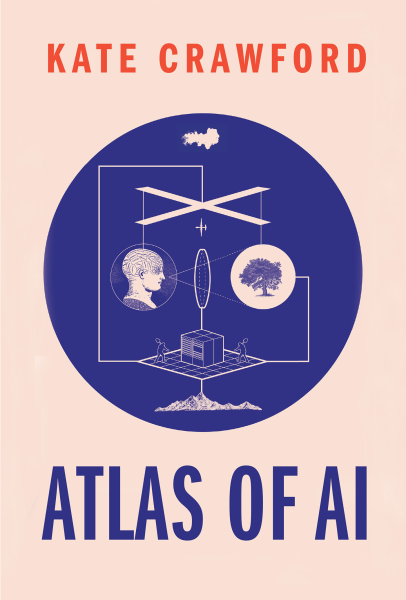
In Kate Crawford’s book Atlas of AI: Power, Politics, and the Planetary Costs of Artificial Intelligence, Crawford critically examines and reveals the material realities of artificial intelligence through a text-based “atlas.” Crawford defines the atlas not merely as a neutral way to represent data but as a collection of aesthetic choices that offer different ways to interpret the data. She frames the maps that make up atlases as collective visions that can be mixed and matched, producing new connections. Ways of organizing and presenting information, like labeling territory on a map or classifying humans in a dataset, are expressions of power. This reflects how, despite popular notions to the contrary, artificial intelligence systems are not objective – they reproduce the power structures under which they are formed and reflect the biases of their creators and the datasets on which they are trained.
In addition to tracing the flow of power, Crawford records the extraction and transportation of raw materials across the globe. This documentation reveals the material realities of artificial intelligence systems hidden by the companies that build them. Through making legible the flow of people and materials through the dimensions of space, time, and status, Crawford uses her reinvented atlas to expose the real world consequences of AI systems.