

It was a sunny Saturday afternoon in May at Naval Cemetery Landscape. Almost twenty of us gathered under the shade where we began the Phytogram workshop. We came from different ages, nationalities, and professions. Let’s relive this afternoon through photos!

The Head of Horticulture at NCL, Avvah, gave us a brief introduction of this land’s history, the variety of plants and insects we can find nesting here. Avvah and Shenghan also engaged us in a discussion about complexity of invasive species designation: How do we acknowledge the botanical reality of “invasiveness” while holding the colonial legacy accountable which have brought these plants here in the first place?

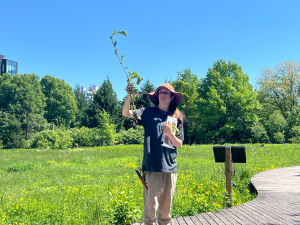

Then Avvah led us in a professional weeding session. We learned how to identify mugwort, and how to weed them. Most people didn’t know anything about mugwort before and now we all became quite the expert. We all got very invested and ended up with so many mugwort 🙂
With our harvested mugwort, Shenghan led us in the collective Phytogram workshop. Citing Karel Doing, with the phytogram process, we can try to simulate what the plants “see” with our human visions, because plants see through chemical reactions.
Shenghan also briefly explained the working mechanism of analogue film development.

The different steps of phytograms: from preparing the eco-developing solution, laying out the 16mm film strips, to soaking the plants and physically applying them onto the films.


Since we are not working in a “real” darkroom, we take the naval cemetery landscape’s beautiful outdoor space as our natural darkroom, employing many DIY methods, such as drying films on the tree branches with wind 🙂


End note:
By spending a whole afternoon thinking about, with, and physically engaging with mugwort and the material reality of film, we found ourselves inhabiting — however briefly — the kind of question that sits at the heart of the M2Lab’s Migration Mapping project: what does it mean to migrate, to be uprooted and re-rooted, to be declared “invasive” in a place you have nonetheless made home? Mugwort didn’t choose to cross oceans; it was carried, just as so many living things — plants, people, images — are carried by forces larger than themselves. As a Sinha Memorial Fellow, I’ve been learning to pay attention to those entanglements: between media and movement, between the botanical and the political, between what a plant “sees” through chemical reaction and what we see when we finally slow down enough to look. The phytogram, with its insistence on letting the plant participate in its own image-making, felt like a small but genuine act of that attention — a reminder that migration is never just a human story, and that the archive we are building together must be wide enough to hold all of it.

About the Naval Cemetery Landscape: The Naval Cemetery Landscape (NCL) is fully operated and made open as a public space by Brooklyn Greenway Initiative (BGI) through the generosity of our supporters. Anyone is welcome to enjoy the space and talk to a gardener about the NCL’s native pollinator habitat and contemplative memorial urban meadow and learn about the NCL and the Greenway and what goes into maintaining their beauty and accessibility for every visitor!